

Successful leaders are expected to make complex decisions, lead through uncertainty, inspire others, and consistently deliver results.
From the outside, they often appear confident and in control.
Behind the scenes, however, many executives face a different reality:
- constant pressure,
- decision fatigue,
- competing priorities,
- difficult conversations,
- organizational change,
- and the expectation to always have the answers.
The challenge isn’t a lack of intelligence or experience.
It’s that leadership becomes increasingly complex as responsibility grows.
This is exactly where executive coaching creates value—not by providing advice, but by improving the quality of a leader’s thinking.
Below are ten common signs that indicate it may be time to work with an executive coach.
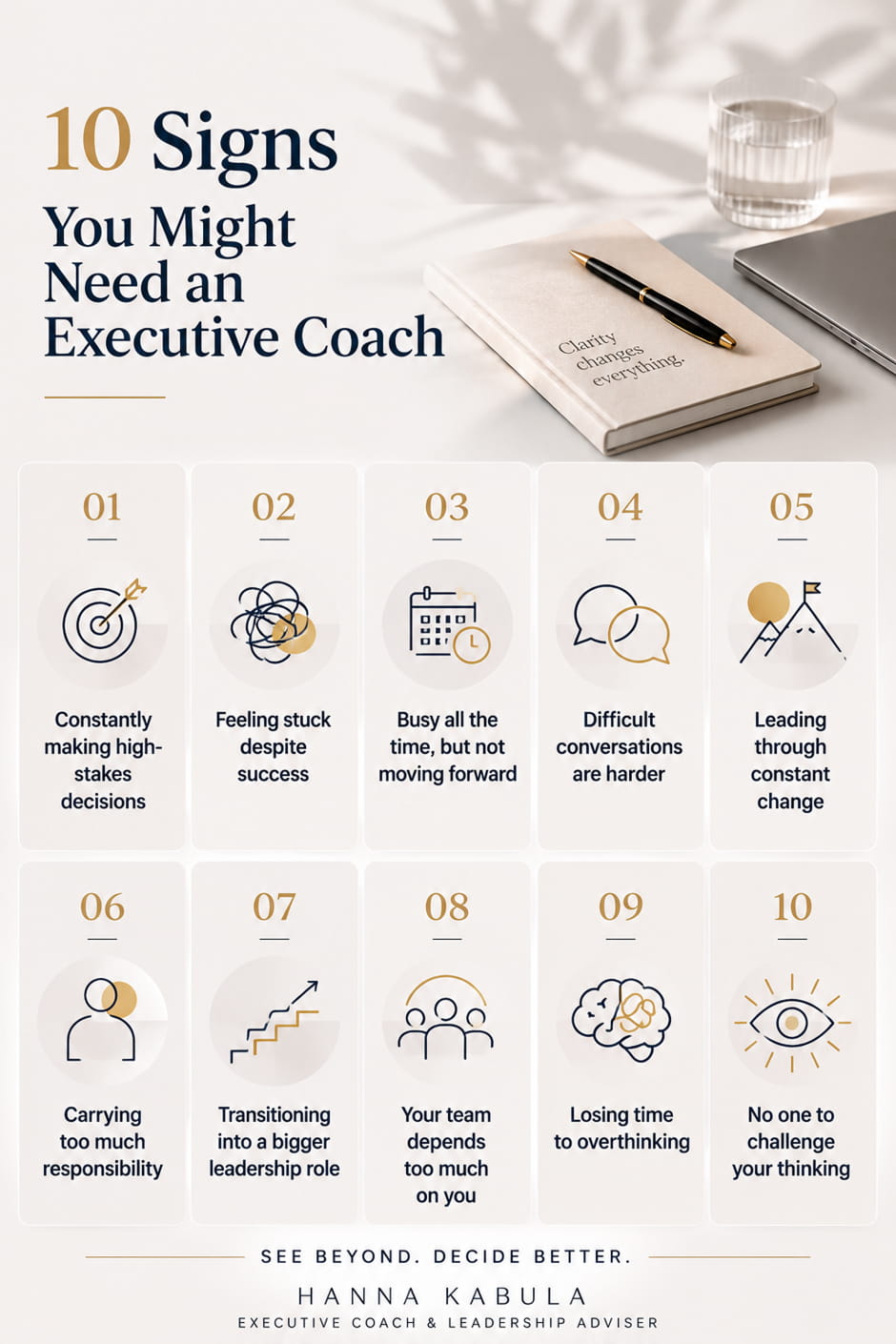
1. You’re Constantly Making High-Stakes Decisions
Every decision carries financial, strategic, or human consequences.
You spend more time evaluating risks than acting.
The pressure to “get it right” slows your thinking.
An executive coach helps you:
- think more strategically,
- reduce decision fatigue,
- gain perspective,
- make confident decisions despite uncertainty.
2. You Feel Stuck—Even Though You’re Successful
From the outside, everything looks fine.
Internally, something feels off.
You may be asking yourself:
- What’s next?
- Is this still the right direction?
- Why does success no longer feel fulfilling?
Coaching creates space to step back, reconnect with your vision, and rediscover clarity.
3. You’re Constantly Busy but Not Making Strategic Progress
Your calendar is full.
Your inbox never stops.
Meetings consume your day.
Yet the truly important work keeps getting postponed.
Executive coaching helps leaders shift from reacting to intentionally leading.
4. Difficult Conversations Are Becoming Harder
Giving feedback.
Managing conflict.
Talking with the board.
Leading underperformance.
Discussing organizational change.
These conversations rarely become easier with experience alone.
A coach helps leaders prepare, communicate with confidence, and stay calm under pressure.
5. You’re Leading Through Constant Change
Today’s organizations rarely experience stability.
Mergers.
Restructuring.
Digital transformation.
Economic uncertainty.
New leadership expectations.
Executive coaching helps leaders navigate ambiguity while maintaining focus and confidence.
6. You Feel Responsible for Everyone
Many leaders carry far more than their official responsibilities.
They solve everyone’s problems.
Protect their teams.
Absorb stress.
Avoid showing vulnerability.
Over time, this creates emotional exhaustion.
A coach provides a confidential space where leaders can think openly without needing to appear strong all the time.
7. You’re Transitioning into a Bigger Leadership Role
Promotion to senior leadership changes everything.
The skills that made you successful before may no longer be enough.
Now success depends on:
- influencing others,
- thinking strategically,
- delegating effectively,
- leading through people rather than doing everything yourself.
Executive coaching accelerates this transition.
8. Your Team Depends Too Much on You
If every important decision comes back to you…
If your team waits for approval before acting…
If delegation feels risky…
The issue may not be capability.
It may be leadership design.
Coaching helps leaders build more empowered, accountable teams.
9. You’re Losing Time to Overthinking
You revisit decisions repeatedly.
You analyze every option.
You hesitate.
You second-guess yourself.
High-performing leaders often confuse careful thinking with endless thinking.
Executive coaching improves decision quality without increasing unnecessary analysis.
10. You Have No One to Challenge Your Thinking
The higher you rise, the fewer people tell you the truth.
Employees may hesitate.
Peers have their own agendas.
Friends don’t fully understand your leadership challenges.
An executive coach becomes an independent thinking partner—someone who asks better questions, expands perspective, and helps you see what you might otherwise miss.
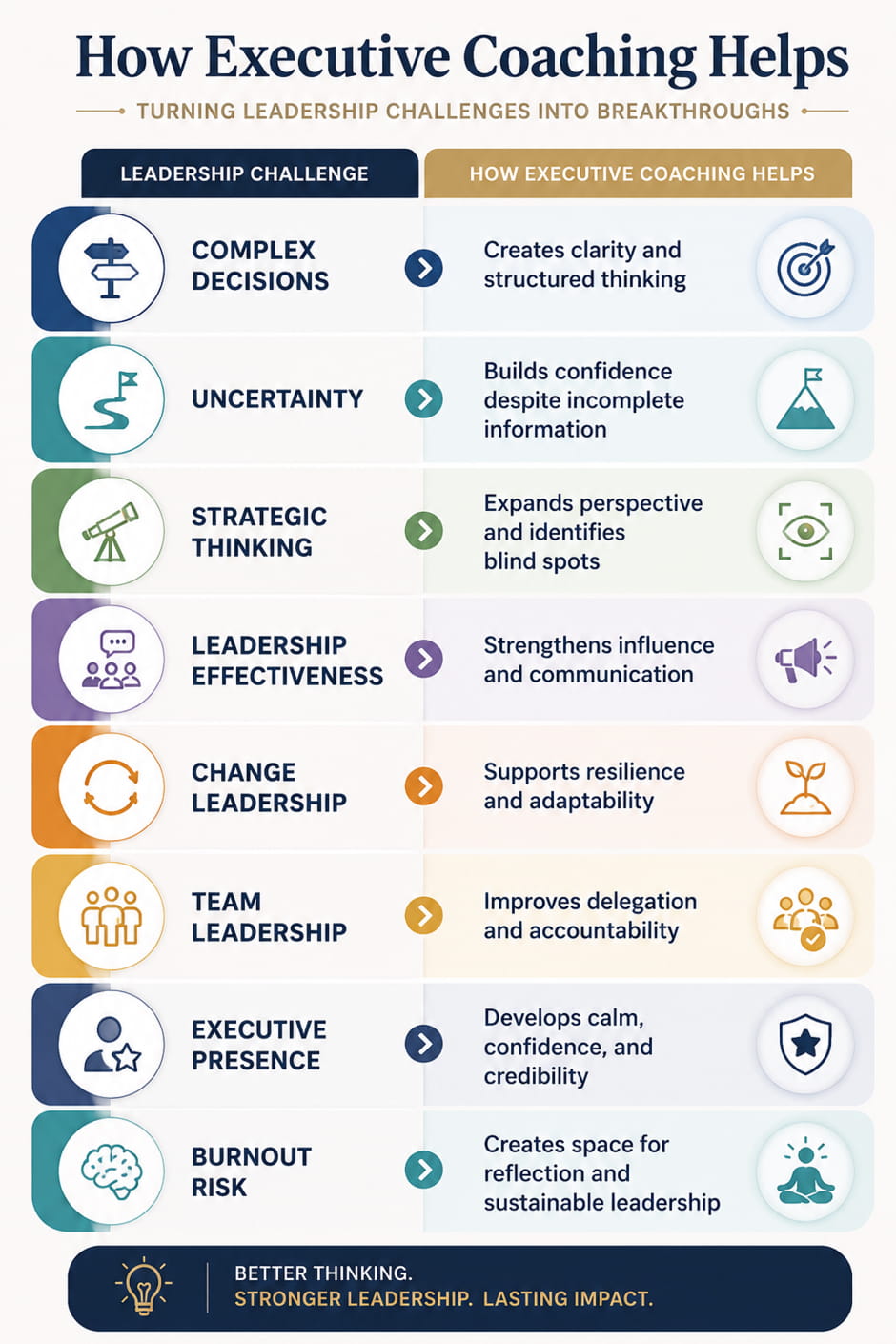
What Executive Coaching Actually Provides
- Executive coaching isn’t consulting.
- It isn’t mentoring.
- It isn’t therapy.
- Instead, it helps leaders improve how they think.
- The result is often.
Why Many Leaders Wait Too Long
One of the biggest misconceptions is that coaching is only for leaders who are struggling.
In reality, many of the world’s most effective executives use coaching while they are already performing well.
They understand that as responsibility increases, so does the need for better thinking—not simply working harder.
The best leaders don’t wait for a crisis.
They invest in their thinking before small challenges become major problems.
Final Thoughts
Leadership becomes more demanding at every level.
The question isn’t whether you can handle complexity.
The question is whether you have the space to think clearly within it.
Executive coaching helps leaders pause, step back from daily pressure, challenge assumptions, and make decisions with greater confidence.
Sometimes the most valuable outcome isn’t finding a new answer.
It’s seeing the situation differently.
Because better leadership begins with better thinking.