

Discover how executive coaching helps leaders strengthen strategic thinking, navigate complexity, make better decisions, and grow into more effective leaders.
Introduction
Executive coaching has become one of the fastest-growing areas of leadership development worldwide. Once considered a resource reserved primarily for CEOs of large corporations, it is now widely embraced by founders, business owners, senior executives, directors, and emerging leaders who are committed to growing their leadership capabilities.
The expectations placed on today’s leaders have changed dramatically. Beyond delivering business results, they are expected to lead organizational transformation, inspire high-performing teams, navigate uncertainty, make strategic decisions, and create environments where people can thrive. At the same time, they often have fewer opportunities for honest reflection and objective conversations about the complex challenges they face.
This is one of the reasons executive coaching has become an essential part of modern leadership development. Rather than offering advice or ready-made solutions, executive coaching provides a confidential environment where leaders can pause, challenge assumptions, broaden their perspective, and make thoughtful decisions with greater confidence.
Whether you are leading a global organization, scaling a growing company, or stepping into your first executive role, working with an executive coach can help you develop the mindset and leadership capabilities needed to succeed in an increasingly complex business environment.
In this guide, you’ll discover what executive coaching is, who benefits most from it, how the coaching process works, what research says about its effectiveness, and why so many successful leaders choose to invest in their own growth.
What Is Executive Coaching?
Executive coaching is a professional partnership that helps leaders strengthen the way they think, lead, and make decisions. At its core, it is not about providing answers—it is about creating the conditions for better thinking.
Unlike consulting, executive coaching does not focus on delivering expert recommendations. Unlike mentoring, it is not based on sharing personal experience or advice. Instead, it is a structured process that encourages leaders to examine their assumptions, explore different perspectives, and identify solutions that fit their unique circumstances.
The most significant leadership challenges rarely have a single correct answer. Questions about organizational growth, business transformation, executive hiring, succession planning, stakeholder management, or long-term strategy require thoughtful analysis rather than quick solutions. An executive coach supports this process by asking insightful questions, encouraging reflection, and helping leaders recognize opportunities they might otherwise overlook.
This is why executive coaching has become one of the most effective approaches to leadership development. It strengthens strategic thinking, improves decision-making, increases self-awareness, and helps leaders navigate complexity with greater clarity and confidence.
Ultimately, executive coaching is not about changing who leaders are. It is about expanding how they think, helping them make better decisions, lead more effectively, and consistently See Beyond.
Who Benefits from Executive Coaching?
Executive coaching is valuable for leaders across industries, organizations, and career stages. While every coaching engagement is tailored to the individual, the leaders who benefit most often share one thing in common: they are responsible for decisions that shape people, teams, strategy, and business performance.
Although their titles may differ, they all face increasing complexity, greater responsibility, and higher expectations. Executive coaching provides the space to think more clearly, lead more intentionally, and continue growing as their roles evolve.
CEOs
The role of a CEO is unlike any other. Every strategic decision has the potential to influence employees, customers, investors, and the long-term direction of the organization. Yet CEOs often have very few people with whom they can openly discuss uncertainty, test ideas, or challenge their own assumptions.
Executive coaching offers a confidential thinking partnership where CEOs can step back from day-to-day demands, gain fresh perspective, and make strategic decisions with greater confidence and clarity.
Founders
Building a successful company requires far more than a great product or business idea. Founders must lead people, shape culture, attract talent, make difficult decisions, and adapt as the business grows.
As organizations become larger and more complex, many founders discover that the skills needed to start a business are different from those required to lead one. Executive coaching supports this transition by helping founders develop the leadership mindset, strategic perspective, and decision-making capabilities needed for sustainable growth.
Senior Executives
Senior executives operate at the intersection of strategy and execution. They manage competing priorities, align stakeholders, lead cross-functional teams, and translate organizational vision into measurable results.
Executive coaching helps senior leaders strengthen executive presence, improve communication, expand strategic thinking, and navigate complex organizational dynamics while maintaining focus on long-term objectives.
Directors
Directors play a critical role in connecting strategy with execution. They are expected to deliver results while leading teams, influencing peers, and responding to changing business priorities.
Executive coaching helps directors strengthen leadership effectiveness, improve collaboration across functions, and prepare for broader executive responsibilities. It also provides an opportunity to step back from operational pressures and think more strategically about the future.
New Leaders
Moving into a leadership role is one of the most significant transitions in any career. Technical expertise alone is no longer enough. Success now depends on the ability to influence others, build trust, delegate effectively, and lead through uncertainty.
Executive coaching helps new leaders develop confidence, strengthen communication, establish healthy leadership habits, and build the executive presence needed to succeed in their new role.
Business Owners
Business owners balance growth, financial performance, customer expectations, innovation, and team development every day. They often carry the weight of important decisions while having limited opportunities to discuss challenges objectively.
Executive coaching creates dedicated space for reflection, helping business owners move beyond daily operations, think strategically, and make decisions that support long-term business success.
No matter the role, one challenge remains remarkably consistent: leadership becomes more complex as responsibility grows. Executive coaching helps leaders navigate that complexity by strengthening not only what they do, but how they think.
Why Do Successful Leaders Work with Executive Coaches?
One of the most common misconceptions about executive coaching is that it is designed for leaders who are struggling. In reality, many of the world’s most successful executives choose to work with an executive coach because they recognize that leadership is never a finished skill—it is an ongoing practice.
As leaders advance in their careers, they gain greater authority, but they often lose something equally valuable: honest, objective feedback. Colleagues may hesitate to challenge their ideas. Team members may avoid difficult conversations. Board members have different priorities, and family or friends rarely understand the complexity of executive leadership.
This can leave even highly experienced leaders making their most important decisions in relative isolation.
Executive coaching provides an independent, confidential environment where leaders can pause, reflect, and think without the pressure to immediately provide answers. It creates the opportunity to challenge assumptions, explore alternative perspectives, and evaluate complex situations before making decisions that affect people, strategy, and business performance.
Many leaders also turn to executive coaching during periods of transition. They may be stepping into a new executive role, leading organizational transformation, preparing for rapid growth, or navigating uncertainty. These moments require more than technical expertise—they require clarity, adaptability, resilience, and thoughtful leadership.
Perhaps the greatest value of executive coaching is that it extends far beyond solving today’s challenges. Leaders develop new ways of thinking that continue to influence how they lead, communicate, and make decisions long after the coaching engagement has ended.
The most successful leaders understand that investing in their own development is not a sign of weakness. It is a commitment to becoming the kind of leader their organization will need tomorrow.
How Executive Coaching Works
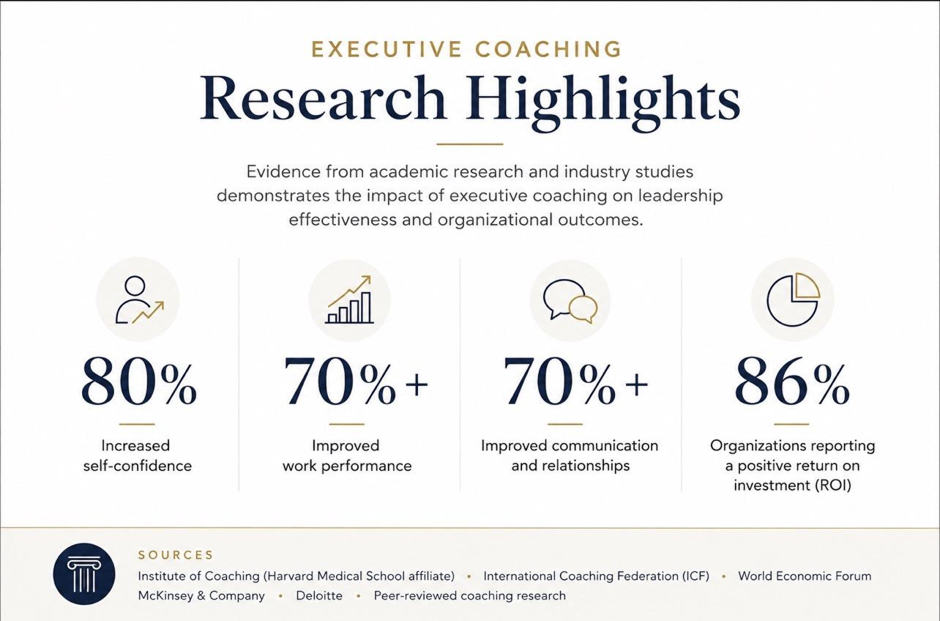
Every executive coaching engagement is unique because every leader brings different goals, challenges, and experiences. There is no standard formula or one-size-fits-all approach. The coaching process is tailored to the individual, the organization, and the context in which leadership decisions are made.
The journey usually begins by defining a clear objective. Some leaders want to become more confident in a new executive role, while others focus on strategic thinking, leading organizational change, strengthening executive presence, or navigating a complex business challenge. Establishing a clear direction helps ensure that coaching remains relevant and focused on meaningful outcomes.
Coaching sessions are built around real situations rather than hypothetical scenarios. Instead of discussing abstract leadership theories, leaders explore current challenges they are facing in their organizations. This practical approach allows coaching conversations to produce insights that can be applied immediately.
Throughout the process, the executive coach asks thoughtful questions, challenges assumptions, and encourages leaders to examine situations from different perspectives. Rather than offering advice, the coach creates an environment where leaders can slow down their thinking, recognize patterns, evaluate options, and make decisions with greater intention.
Between sessions, leaders apply new insights in their daily work. They observe the impact of their decisions, reflect on what they learn, and continue refining their leadership approach. Over time, these small shifts accumulate into lasting changes in how they think, communicate, and lead.
The value of executive coaching is not measured by the number of sessions completed. It is reflected in the leader’s ability to approach future challenges with greater clarity, stronger judgment, and increased confidence. The goal is not to become dependent on a coach, but to develop the mindset and capabilities that support effective leadership long after the coaching engagement has ended.
Executive Coaching vs Consulting vs Mentoring
Executive coaching is often compared with consulting and mentoring because all three approaches contribute to professional growth. While they may complement one another, they are designed to achieve different outcomes.
A consultant is typically engaged to solve a business problem. Drawing on specialized expertise, consultants analyze situations, identify opportunities, and recommend solutions. Their value lies in providing expert knowledge and practical recommendations.
A mentor, by contrast, shares personal experience. Having faced similar challenges, mentors offer guidance, lessons learned, and career advice that can help others navigate their own professional journey.
Executive coaching follows a different philosophy. Rather than providing answers, an executive coach helps leaders develop their own ability to think critically, evaluate complexity, and make informed decisions. The focus is not on transferring knowledge but on strengthening leadership capability.
This distinction becomes especially important when there is no obvious solution. Leadership rarely presents problems with a single correct answer. Decisions involving organizational change, executive hiring, business growth, or strategic direction require careful judgment rather than predetermined formulas. Executive coaching helps leaders build that judgment.
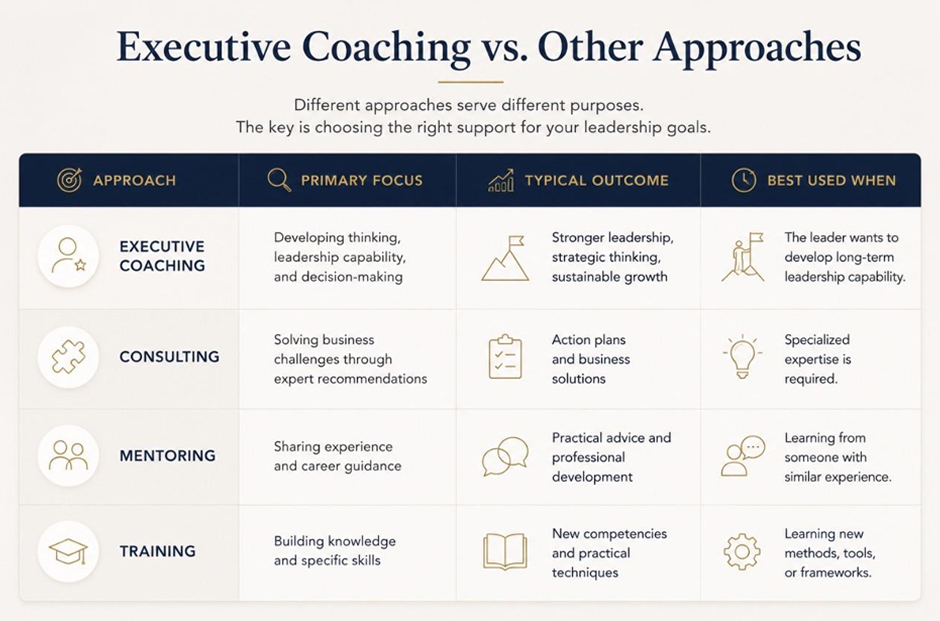
The most successful organizations recognize that consulting, mentoring, training, and executive coaching each have an important role. Consulting delivers expertise. Mentoring shares experience. Training builds skills. Executive coaching develops the leader’s ability to think, adapt, and lead effectively in situations where no handbook can provide the answer.
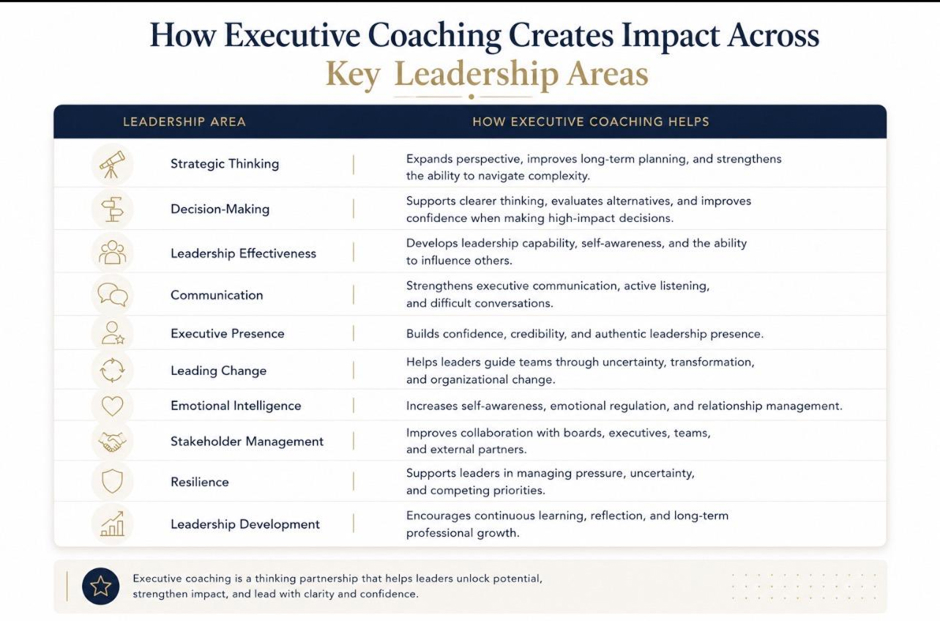 While every coaching engagement is unique, the outcomes often extend beyond individual performance. As leaders strengthen their thinking, communication, and decision-making, teams become more aligned, collaboration improves, and organizations are better equipped to navigate change. This is why executive coaching is increasingly viewed as a strategic investment in long-term leadership capability rather than a short-term intervention.
Final Thoughts
Executive coaching is not about having someone else make decisions for you.
It is about creating the conditions to make better decisions yourself.
As leaders progress in their careers, the challenges they face become increasingly complex. Expectations continue to grow, uncertainty becomes a constant, and opportunities for honest reflection become increasingly limited. In this environment, the ability to think clearly is no longer simply a leadership advantage—it has become a leadership necessity.
Executive coaching provides a structured space for that thinking. It helps leaders step back from daily pressures, challenge assumptions, explore different perspectives, and make decisions with greater confidence and intention.
The value of executive coaching is not measured by the number of coaching sessions completed. It is measured by the quality of the decisions leaders make, the relationships they build, the teams they develop, and the long-term impact they create within their organizations.
- Great leadership is rarely about having all the answers.
- It is about asking better questions.
- Remaining curious.
- Continuing to learn.
- And seeing possibilities where others see only complexity.
- That is the essence of executive coaching.
- See Beyond. Lead with Clarity. Create Lasting Impact.