

The strongest leaders know they don’t have to think alone.
From the outside, successful leaders often appear confident, decisive, and in control.
They lead organizations through uncertainty, make decisions that affect hundreds—or even thousands—of people, and carry responsibilities few truly understand.
Because of this, many people assume they no longer need support.
In reality, the opposite is true.
The higher leaders rise, the fewer opportunities they have for honest thinking, unbiased feedback, and meaningful reflection.
Executive coaching isn’t a sign of weakness.
It’s a strategic advantage.
Leadership Has Changed
Leadership today looks very different than it did even ten years ago.
Today’s executives aren’t simply managing operations.
They’re expected to:
- lead through uncertainty;
- inspire diverse teams;
- make strategic decisions quickly;
- navigate constant change;
- balance short-term performance with long-term vision.
Technical expertise is no longer enough.
Leadership has become a thinking discipline.
The quality of leadership increasingly depends on the quality of thinking behind every decision.
The Leadership Myth
Many successful executives quietly believe:
“If I’m successful, I should already know the answers.”
But modern leadership doesn’t reward certainty.
It rewards curiosity.
The best leaders don’t pretend to know everything.
They create better conditions for better thinking.
Myth vs Reality
| Leadership Myth | Leadership Reality |
| Strong leaders always know the answer. | Strong leaders ask better questions. |
| Asking for support signals weakness. | Seeking perspective demonstrates wisdom. |
| Experience eliminates uncertainty. | Experience improves judgment—not certainty. |
| Leaders should solve everything alone. | Great leadership is strengthened through reflection. |
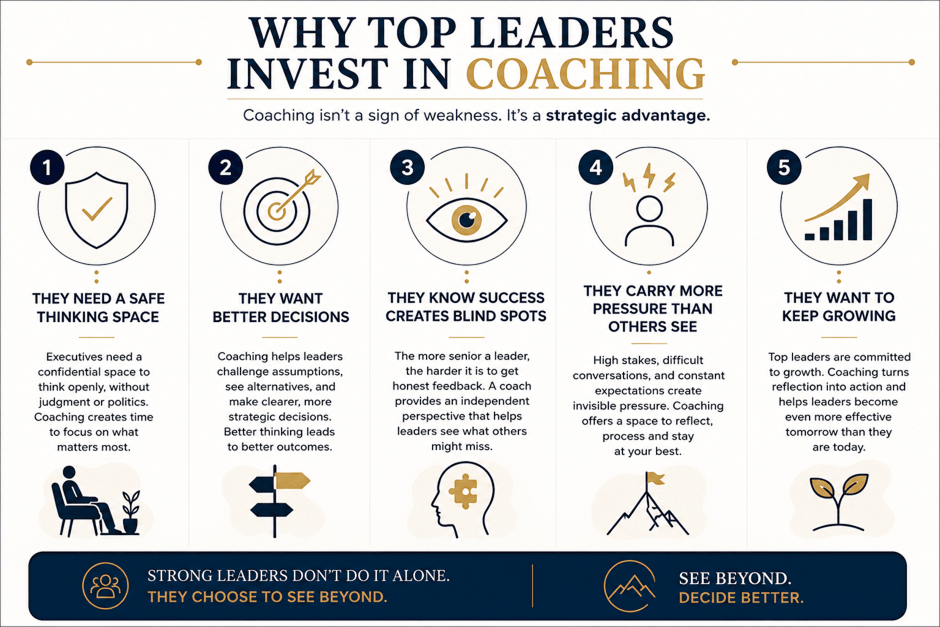
Executive coaching has become common among CEOs, founders, senior executives, and leadership teams—not because they lack capability, but because leadership becomes increasingly complex as responsibility grows.
The greatest value of coaching isn’t advice.
It’s creating the conditions for better thinking.
1. They Need a Safe Thinking Space
Executives spend most of their time helping others solve problems.
Very few people help executives think about their own.
Leadership often becomes lonely.
There are conversations leaders cannot have with their teams.
Questions they cannot ask their board.
Uncertainty they don’t want to share publicly.
Executive coaching creates something increasingly rare:
A confidential thinking space.
A place without politics.
Without judgment.
Without expectations.
Simply space to think.
2. They Want Better Decisions
Every significant leadership challenge eventually becomes a decision.
Hire or not?
Invest or wait?
Expand or consolidate?
Speak now or later?
An executive coach doesn’t make those decisions.
Instead, coaching improves the thinking that produces them.
Coaching helps leaders:
- identify assumptions;
- recognize blind spots;
- evaluate multiple perspectives;
- reduce emotional bias;
- clarify priorities.
Better thinking creates better decisions.
3. Success Creates Blind Spots
Success changes the feedback leaders receive.
As influence grows, honesty often decreases.
People naturally protect relationships, avoid conflict, or tell senior leaders what they believe leaders want to hear.
This creates blind spots.
Not because leaders lack intelligence—
because perspective becomes limited.
An executive coach provides independent thinking without hierarchy, politics, or hidden agendas.
4. Leadership Pressure Is Mostly Invisible
From the outside, leadership looks confident.
Inside, it often feels different.
Executives regularly carry:
- board expectations;
- financial responsibility;
- difficult personnel decisions;
- organizational transformation;
- strategic uncertainty;
- pressure to deliver results.
Few people see that weight.
Fewer understand it.
Coaching creates space to process pressure before pressure begins affecting judgment.
Executive Pressure Is Often Invisible
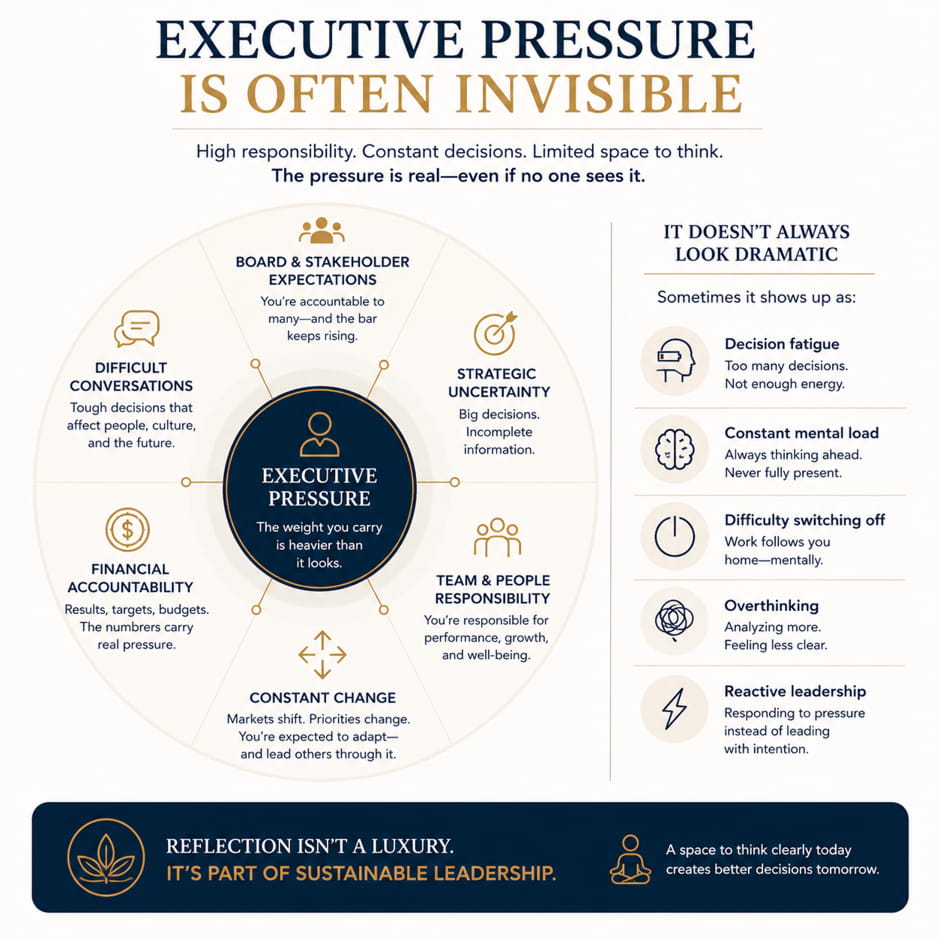
Pressure doesn’t always look dramatic.
Sometimes it appears as:
- decision fatigue;
- constant mental load;
- difficulty switching off;
- overthinking;
- reactive leadership.
Reflection isn’t a luxury.
It’s part of sustainable leadership.
5. They Never Stop Growing
Exceptional leaders don’t believe they’ve arrived.
Instead, they ask:
- What am I missing?
- Where are my blind spots?
- What does my team need from me now?
- What kind of leader must I become next?
Growth becomes intentional.
Not accidental.
Leadership Challenge → Executive Coaching Impact
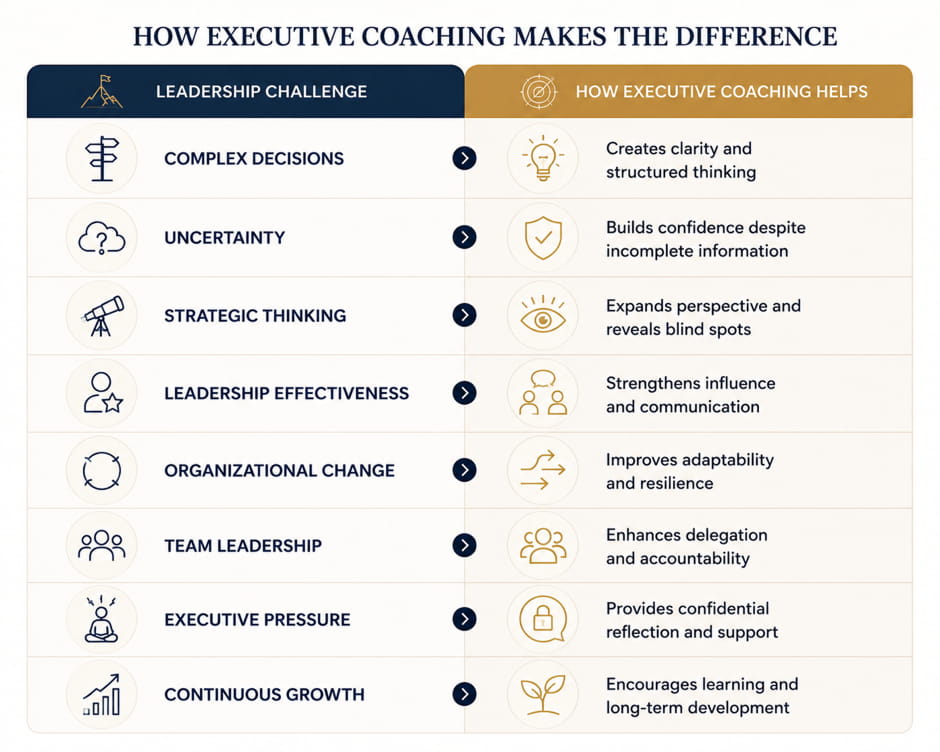
Coaching Is Not About Advice
Executive coaching is one of the most misunderstood leadership development tools.
People often imagine coaches providing answers.
That’s consulting.
Coaching works differently.
Instead of telling leaders what to do, coaching helps leaders:
- think more clearly;
- challenge assumptions;
- explore possibilities;
- make decisions aligned with values;
- strengthen strategic judgment.
The goal isn’t dependence on a coach.
The goal is stronger independent leadership.
| Coaching IS NOT | Coaching IS |
| Giving advice | Asking powerful questions |
| Consulting | Developing thinking |
| Mentoring | Expanding perspective |
| Therapy | Supporting leadership decisions |
| Telling leaders what to do | Helping leaders think better |
The See Beyond Leadership Framework
Complexity
↓
Pause
↓
Perspective
↓
Challenge Assumptions
↓
See Beyond
↓
Confident Decisions
↓
Leadership Impact
Why This Matters
Leadership rarely improves by working harder.
It improves by thinking differently.
Every meaningful leadership decision begins long before action.
It begins with perspective.
Final Thought
The world’s strongest leaders don’t work with executive coaches because they’re struggling.
They work with coaches because they understand something fundamental:
As responsibility grows, so does the importance of thinking well.
Executive coaching protects the one leadership capability that influences every other:
The ability to think clearly in complexity.
Because leadership isn’t about having every answer.
It’s about seeing what others don’t.
Ready to See Beyond?
If you’re leading through complexity, making high-impact decisions, or preparing for your next leadership challenge, you don’t have to navigate it alone.
A Clarity Session provides a confidential space to think strategically, gain perspective, and make confident decisions.
See Beyond. Decide Better.